News

All News

April 10, 2025

Congratulations to Nafisa Rashid, who has received the FLAS Fellowship for Japan to study at the Inter-University Center for Japanese Language Studies for the summer!

Julia Peck gave a talk at ucLADINO, the annual Ladino language conference hosted by UCLA, where she launched the digital version of her at-home language nesting project, Ladino en Kaza. The project equips Ladino learners to create a language nest in their kitchens. She was recently awarded a Diller Family Foundation fellowship to support the project's continuation and expansion into more rooms of the home.

Congratulations to Maksymilian Dąbkowski, whose article "Deglottalizing contamination in A’ingae historical derivatives" was published in Proceedings of the Linguistic Society of America!

April 7, 2025

Jhonni Carr delivered a live-streamed lecture at la Universidad Autónoma de Campeche on April 2 titled "Come work from Mexico, it’s truly magical: la gentrificación lingüística de Mazunte, Oaxaca."

April 6, 2025

The 2024-2025 colloquium series concludes on Monday, April 14, with a talk by Yi Ting Huang (Maryland), taking place in Dwinelle 370 and on Zoom (passcode: lx-colloq) from 3:10-4:30pm. The title of her talk is "Learning language, fast and slow: How to overcome sparse data and signal degradation during real-time processing and development." The abstract is as follows:

Traditional approaches to language development focus on relationships between aggregate inputs (e.g., total words heard) and outcomes (e.g., vocabulary size), assuming that what parents say is what children learn. This, of course, ignores an obvious fact about acquisition – Children initially have no idea what parents are talking about. Instead, they must infer linguistic representations through iterative encounters with sentences. To better understand these processes, I will introduce three lines of research that describe developmental algorithms for sentence processing, and their variation with language experience and impairment status. First, I will examine how 4- to 6-year-olds determine who did what to whom in sentences, and show ways in which their strategies vary with properties of the communicative context. Second, I will take a closer look at SES language gaps, and show how systematic variation in language experiences preserve learning ability but alter sentence-processing strategies. Finally, we will turn to children with Developmental Language Disorder, who face profound difficulties producing, understanding, and learning from language in the school-aged years. We present preliminary findings from a randomized controlled trial to alter sentence processing and improve comprehension. We will close by considering causal pathways between chronometric and ontogenetic processes, and discuss their implications for how children recreate language from input, what a satisfying algorithmic-level description of language acquisition might look like, and why more cognitive scientists should be working at the intersection of basic and translational research.

April 4, 2025

In and around the Department of Linguistics in the next week:

April 3, 2025

Isaac L. Bleaman will be giving a research talk for the Department of Germanic Languages & Literatures at the University of Toronto on Thursday, April 10. The title of his talk is "Preserving the Past, Forging the Future: Digital Voices in Yiddish Studies." He will also be leading a workshop for Yiddish instructors on Friday, April 11 titled "אױספּאַקן דעם טערמינאָלאָגישן באַגאַזש: מכּוח ייִדישע װערבן" (When Less Is More: On Yiddish Grammatical Terminology).

Congratulations to Amy Rose Deal and Justin Royer (Université de Montréal), whose article "Mayan animacy hierarchy effects and the dynamics of Agree" has just been published online in Natural Language & Linguistic Theory!

April 2, 2025

Calques is saddened to report the passing of Berkeley Linguistics PhD alumna Miriam R. L. Petruck.

Dr. Petruck was active in the linguistics research community until her passing. She recently received a Fulbright Distinguished Scholar Award to create a FrameNet-inspired database of structured information about the experiences of Holocaust survivors.

April 1, 2025

An interview with Isaac L. Bleaman about Yiddish corpus development was just published in In geveb: A Journal of Yiddish Studies. Click here to read it!

Congratulations to Justin Davidson on receiving the 2025 Carol D. Soc Distinguished Graduate Student Mentoring Award in recognition of his outstanding commitment to graduate student success.

March 31, 2025

Gašper Beguš appeared in Berkeley News with a video explaining his work on AI and language in 101 seconds. Click here to see it!

Congratulations to Isaac L. Bleaman and Chaya R. Nove (Brown University) on the publication of their article "The Corpus of Spoken Yiddish in Europe: Goals, methods, and applications" in Language Documentation & Conservation!

Andrew Garrett's review of James McElvenny's A history of modern linguistics (2024) has appeared in Language 101 (2025), 195-199 (link here).

March 21, 2025

In and around the Department of Linguistics today and in the week following Spring Break:

March 17, 2025

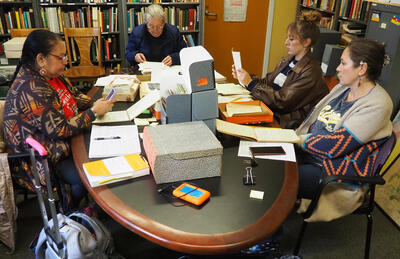
Here's the latest from the California Language Archive:

March 14, 2025

In and around the Department of Linguistics in the next week:

March 13, 2025

Last week Amy Rose Deal traveled to Massachusetts to give talks at UMass and in the MIT colloquium series (on case sensitivity in syntax), along with a ling-lunch talk on de re attitude reports.

March 11, 2025

Congratulations to Nicole Holliday and Paul E. Reed (University of Alabama) on the publication of their article "Gender and racial bias issues in a commercial 'tone of voice' analysis system" in PLoS ONE!

March 10, 2025

The 2024-2025 colloquium series continues on Monday, March 17, with a talk by Kathryn Davidson (Harvard), taking place in Dwinelle 370 and on Zoom (passcode: lx-colloq) from 3:10-4:30pm. Her talk is entitled "Information Structure Insights from Sign Language Anaphora." The abstract is as follows:

Notions of topic and focus have been well-studied in sign languages, which - like many spoken languages - tend to have word orders highly influenced by information structural considerations, along with perhaps some modality-specific considerations provided by suprasegmental "non-manuals" and other simultaneous expression, the tight integration of iconic depiction into the grammatical structure, etc. The use of three-dimensional signing space for tracking referents across a discourse is often considered to be another modality-specific feature, bearing on questions about the syntactic, semantic, and pragmatic representation of anaphora in language more generally and how anaphoricity relates to other notions like definiteness, givenness, and contrast. This talk will provide new empirical arguments from sign languages for how the expression of contrast falls out as a consequence of marking (explicit and implicit) discourse familiarity and non-identity and what this means for how we should think about the relationship between anaphoricity, alternatives, and information structure.