News

All News

October 17, 2025

In and around the Department of Linguistics in the next week:

October 16, 2025

Congratulations to Maksymilian Dąbkowski, who filed his dissertation, "Metrical stress and glottal stops in A'ingae: A study of cyclicity and dominance at the interface of phonology and morphology," on October 8! Maks has accepted a position as Research Assistant Professor at the University of Hong Kong (HKU) beginning January 1.

Zachary O'Hagan is speaking about Indigenous languages and archives at the Berkeley Breakfast Club on Friday, October 17.

Here's the latest from the California Language Archive:

Gašper Beguš's project titled "Deep language learning: from fiwGAN to LLMs" has won the Peder Sather Grant. The grant will allow a collaboration and several workshops at the University of Oslo and UC Berkeley.

October 14, 2025

Congratulations to Amy Rose Deal, who has a new article entitled "Uncentered attitude reports" out in the Journal of Semantics.

October 13, 2025

Richard Rhodes will be giving a paper at the 57th Algonquian Conference, hosted at the University of Winnipeg from October 17 to 19, 2025. The title of his presentation is "On the History of the Cree Languages."

On October 3, Line Mikkelsen gave the 2025 Prytanean Lecture in connection with homecoming. She spoke about her cross-Atlantic collaboration with Kalaallisut speakers Grethe Schmidt and Ellen Thrane.

October 10, 2025

In and around the Department of Linguistics in the next week:

  • Fieldwork Forum - Wednesday Oct 15 - Dwinelle 1303 and Zoom - 3-4pm
    Nadine Grimm (Rochester): "Tone in Grammar and Grammar-Writing"
  • Phorum - Friday Oct 10 - Dwinelle 1229 - 4:10-5pm
    Hannah Sande and Sansan Claude Hien (UC Berkeley): "Puzzles in the Lobi (Gur) tone system: Downstep and floating tones"
  • Phorum - Friday Oct 17 - Dwinelle 1229 - 4:10-5pm
    Grace Brown (Stanford): "Gender Identity and Ideology Shape Perceptions of Masculinity in Male Speech"
  • Sociolinguistics Lab at Berkeley - Friday Oct 10 - Dwinelle 5125 - 3-4pm
    Julian Vargo (UC Berkeley): "Acoustical Diphthongal Trajectory Variation in Hispanic Californian English"
  • Sociolinguistics Lab at Berkeley - Friday Oct 17 - Dwinelle 5125 - 3-4pm
    Becky Everson (UC Berkeley): "Linguistic Elicitation and Style in a Language Documentation Context: Variable Click Production in Tjhauba"
  • Syntax and Semantics Circle - Friday Oct 10 - Dwinelle 1303 and Zoom - 3:10-4:30pm
    Philip Shushurin: "Rethinking Adjacency: Deriving linear constraints in the Russian Noun Phrase (and beyond)" (Zoom talk)

October 7, 2025

Lev Michael and Christine Beier have just published a chapter titled "Non-verbal predication in Zaparoan languages" in Non-verbal predication in the world's languages, edited by Pier Marco Bertinetto, Luca Ciucci, and Denis Creissels (De Gruyter Brill).

October 3, 2025

In and around the Department of Linguistics in the next week:

October 2, 2025

Gašper Beguš's work on modeling language in humans, animals, and machines was featured in Communications of the ACM, the official publication of the Association for Computing Machinery: https://cacm.acm.org/news/can-ai-talk-to-the-animals/

Congratulations to Alexandra Pfiffner on the publication of a new article, "Women of all ages lead tonogenesis in Afrikaans," in the Journal of Germanic Linguistics. Open access here!

September 29, 2025

On Friday evening, at the end of the main session of AMP 2025, a Festschrift was announced in honor of Sharon Inkelas. Sharon's research has a profound influence on the fields of phonology and morphology, and her influence as a teacher, mentor, colleague, friend, and now administrator will also have a lasting impact on the field of linguistics and beyond.

Festschrift details:
Phonology at its interfaces
Edited by Hannah Sande, Larry Hyman, Darya Kavitskaya, Anne Pycha, Stephanie Shih, and Alan Yu

Table of Contents

Part 1: Phonology: representations and phenomena

  • Florian Lionnet: Ineffability as a window into hidden grammar in Laal
  • Andrew Garrett and Kai Schenck: Yurok rhotic vowels and vowel harmony: Phonetics, phonology, and morphology
  • Paul Kiparsky: Neutrality and Harmony: A Finnish Perspective
  • Larry M. Hyman & Mwaambi G. Mbûûi: The Superhigh Tone in Tiania (Kimeru, Kenya)
  • Karee Garvin and Myriam Lapierre: Integrating Q Theory with Moraic Theory: A case study from Nanti stress
  • David Mortenson: Paradigm Completion in Yoloxóchitl Mixtec: An Exploration of Some Computational Consequences of Q-Theory
Part 2: At the interface of phonology and morphology
  • Yuni Kim: Cophonologies in the lexicon: an analysis of Coatlán Mixe verb stem allomorphy
  • Mary Paster: Phonological identity and similarity effects on affixation
  • Gabriela Caballero: Templatic truncation and metrical structure in Choguita Rarámuri length-alternating allomorphy
  • Draga Zec: Phonology within morphology in South Slavic: the case of OV augmentation
  • Nicholas Rolle, Emily Clem, and Virginia Dawson: Displacement as a response to non-local allomorphy: Evidence from Tiwa
Part 3: Phonological interfaces beyond morphology
  • Tara McAllister + Yvan Rose: Trajectories for the elimination of child phonological patterns
  • Alan Yu: Infixing pragmatically: Expressive infixation in English and Cantonese
  • Peter Jenks and Hannah Sande: Prosodic inversion as infixation
  • Stephanie S Shih; Jordan Ackerman; Noah Hermalin; Sharon Inkelas; Hayeun Jang; Jessica Johnson; Darya Kavitskaya, Shigeto Kawahara; Miran Oh; Rebecca L. Starr; Alan Yu: Cross-linguistic and language-specific sound symbolism: Pokémonastics 

The 2025-2026 Linguistics Colloquium series continues on Monday, October 6, with a talk by Tom McCoy (Yale). The talk will take place in Dwinelle 370 and synchronously via Zoom (password: lx-colloq) from 3:10-4:30pm. The title is "Using neural networks to test hypotheses about language acquisition" and the abstract is as follows:

A central challenge in linguistics is understanding how children acquire their first language. A variety of influential hypotheses have been put forth about the learning strategies that children might use (e.g., the syntactic bootstrapping hypothesis: Gleitman 1990). Such hypotheses have received important empirical support in controlled experimental settings (e.g., Naigles 1990), but it is challenging to test whether these hypotheses continue to hold for children’s large-scale, naturalistic input because it would be unethical to perform extensive interventions on a child’s primary linguistic data. In this talk, I will discuss how neural network language models - the type of system powering ChatGPT - can be used to test hypotheses about which strategies are effective for learning from naturalistic child-directed language, providing a source of evidence that complements the controlled experiments that can be run with actual children. I will discuss two case studies that use this paradigm. The first case study focuses on the aforementioned syntactic bootstrapping hypothesis, which postulates that syntax plays a critical role in the acquisition of word meaning, especially for verbs. In support of this hypothesis, we find that syntactic information is central to the ability of neural networks to learn verb meanings. The second case study focuses on the poverty of the stimulus argument as it pertains to English polar questions - the argument that children’s input does not provide strong enough evidence for generic learning algorithms to recognize that English yes/no questions are driven by syntactic tree structure. In accordance with this argument, we find that neural networks trained on child-directed language struggle to learn the syntax-sensitive nature of this phenomenon. Taken together, these results illustrate one way in which neural network models can contribute to linguistic theory. (Work done in collaboration with Xiaomeng Miranda Zhu, Aditya Yedetore, Robert Frank, and Tal Linzen).

September 26, 2025

In and around the Department of Linguistics in the next week:

September 25, 2025

Aurora Martinez Kane has just concluded her tenure as a Greenleaf Visiting Scholar at the University of New Mexico. On her two-month trip, she did a mix of work with archival materials and field interviews with New Mexican Spanish speakers for her dissertation project in consultation with UNM faculty and archivists.

September 23, 2025

Larry Hyman gave a colloquium at the University of Rochester on September 12: "Prosodic domains in the Bantu noun phrase."

He also made a presentation on "Limba verb extensions in Niger-Congo perspective" in Nadine Grimm's "Languages of Africa" class on September 11, 2025.

September 21, 2025

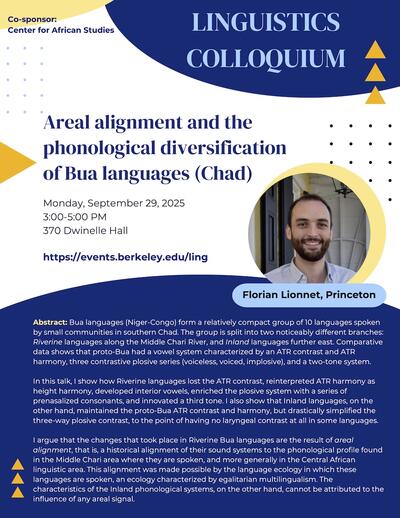
The 2025-2026 Linguistics Colloquium series continues on Monday, September 29, with a talk by Florian Lionnet (Princeton). The talk will take place in Dwinelle 370 and synchronously via Zoom (password: lx-colloq) from 3:10-4:30pm. The title is "Areal alignment and the phonological diversification of Bua languages (Chad)" and the abstract is as follows:

Bua languages (Niger-Congo) form a relatively compact group of 10 languages spoken by small communities in southern Chad. The group is split into two noticeably different branches: Riverine languages along the Middle Chari River, and Inland languages further east. Comparative data shows that proto-Bua had a vowel system characterized by an ATR contrast and ATR harmony, three contrastive plosive series (voiceless, voiced, implosive), and a two-tone system.

In this talk, I show how Riverine languages lost the ATR contrast, reinterpreted ATR harmony as height harmony, developed interior vowels, enriched the plosive system with a series of prenasalized consonants, and innovated a third tone. I also show that Inland languages, on the other hand, maintained the proto-Bua ATR contrast and harmony, but drastically simplified the three-way plosive contrast, to the point of having no laryngeal contrast at all in some languages.

I argue that the changes that took place in Riverine Bua languages are the result of areal alignment, that is, a historical alignment of their sound systems to the phonological profile found in the Middle Chari area where they are spoken, and more generally in the Central African linguistic area. This alignment was made possible by the language ecology in which these languages are spoken, an ecology characterized by egalitarian multilingualism. The characteristics of the Inland phonological systems, on the other hand, cannot be attributed to the influence of any areal signal.